



Does HECS debt affect your home loan? It’s the question on every Australian graduate’s mind, and in 2026, the answer has changed significantly. As an experienced mortgage broker Brisbane buyers trust, we’ve seen Australian lenders radically shift how they view student loans, moving away from rigid liabilities toward more flexible “Debt-to-Income” (DTI) assessments.
Whether you’re looking to maximize your borrowing power under the latest APRA guidelines or escape a “mortgage prison” while refinancing, this guide breaks down exactly how to position your HECS debt for a successful bank approval.
Hecs Debt And Your Home Loan: What Changed In 2025

HECS Debt Relief 2025: 20% Debt Reduction
From 1 June 2025, the government automatically cut HELP debt balances by 20%—approximately a $5,520 reduction on average outstanding debt of $27,600.
The reduction applies retroactively and is handled automatically by the ATO—no action is required from borrowers.
HECS Home Loan Changes: New Lending Rules
From 30 September 2025, the Australian Prudential Regulation Authority (APRA) is introducing new guidance around how lenders assess HECS-HELP debt.
Previously, lenders always counted student debt as an ongoing financial liability. But under the new policy:
- Lenders can choose to exclude HECS/HELP debt if it will be repaid in full within 12 months.
- Some banks may reduce the servicing buffer if the debt is due to be cleared in the next 2–5 years.
Real-World Example: CommBank Changes
Commonwealth Bank (CBA) has already rolled out changes ahead of this regulatory update. Here is an example of how a couple’s borrowing power will change:
Borrower Profile | Before CBA Policy Change | After CBA Policy Change |
Couple earning $180,000/year | $840,000 borrowing power | $1.02 million |
These changes boosted borrowing capacity by $180,000, simply because the HECS debt was being repaid soon.
Expect other major lenders to follow suit closer to the deadline.
Tip: Be upfront with your mortgage broker about your HECS repayment timeline—it could change how your application is assessed.
How Do HECS/HELP Debt Work?

In Australia, citizens can borrow money from the Australian Government to pay their course fees. This loan is called HECS-HELP.
- Higher Education Contribution Scheme (HECS)
- Higher Education Loan Program (HELP)
During your studies, the Government pays the loan amount to your educational institution. Then, when you have finished studying and are earning an income, you begin your loan repayments. These repayments are made directly to the Australian taxation system and are often shown on your payslip.
Here is the fine print:
- Repayments start when your repayment income exceeds $67,000 (from 2025–26).
- You repay only on income above the threshold.
- Rates escalate up to 10% at higher income levels.
- Debt grows each June with indexation, though recent caps reduced spikes.
- From June 2025, eligible borrowers get a 20% loan balance reduction.
HECS Repayment Rates (2025–26 Income Year)
If you earn below $67,000, your compulsory repayment is $0. For every dollar you earn above that, here is how the math works under the latest policy:
Current Repayment Income | Marginal Repayment Rate |
Below $67,000 | Nil |
$67,001 – $125,000 | 15c for every $1 over $67,000 |
$125,001 – $179,285 | $8,700 + 17c for every $1 over $125,000 |
$179,286 and over | Capped at 10% of total income |
How Repayments Are Collected
- Your repayment income includes taxable income, net investment losses, fringe benefits, reportable super contributions, and foreign income.
- Employers withhold amounts via payroll, but actual repayment is confirmed at tax time through your tax return.
What Is HECS Indexation—And Why Has My Debt Gone Up?
HECS-HELP loans are interest-free—but they do get indexed every year based on inflation.
This means your debt grows slightly each year, even if you aren’t making repayments.
In June 2024, the indexation rate was 7.1%—the highest in years.
Original Debt | Indexation Rate | New Balance (Post-Indexation) |
$10,000 | 7.1% | $10,710 |
$25,000 | 7.1% | $26,775 |
So even if you paid $1,000 towards your loan in a year, the balance could still grow.
To check your indexed debt:
- Log in to myGov
- Go to your ATO account
- Check the “Loan Balances” section
Helpful Tip: Indexation applies every 1st of June, so if you’re planning a voluntary repayment, do it before May 31 to reduce the amount that gets indexed.
How Does A Hecs Debt Affect A Home Loan?

When applying for a home loan in Australia, your HECS-HELP debt can impact your borrowing capacity, even though it’s technically not considered a traditional debt like credit cards or personal loans. At the start of any loan application, you must disclose any outstanding debts—including your HECS-HELP loan.
Why Lenders Care About Your HECS-HELP Debt
While HECS-HELP doesn’t require regular fixed repayments, it still affects your repayment income. Depending on how much you earn, the Australian Tax Office may already be deducting repayments from your salary. Lenders factor these repayments in when calculating your debt-to-income ratio, which determines how much you can safely borrow.
Even if you’re not actively repaying the debt yet (because your income is below the threshold), lenders will anticipate future repayments and adjust your loan eligibility accordingly.
How Much Does HECS Affect Borrowing Power?

Student debt doesn’t come with interest—but it can still lower your borrowing power.
The general rule is:
Your borrowing power reduces by about 10× your annual HECS repayment.
So if you’re repaying 3% of your salary, you could see a 30% equivalent drop in how much income lenders count.
Example: Income vs HECS Repayment vs Borrowing Power
| Annual Income | New Marginal Repayment (2026) | Estimated Borrowing Power Impact |
| $67,000 | $0 | $0 (No impact on serviceability) |
| $75,000 | $1,200 /yr ($100/mo) | -$15,000 to -$20,000 |
| $100,000 | $4,950 /yr ($412/mo) | -$55,000 to -$65,000 |
| $120,000 | $7,950 /yr ($662/mo) | -$85,000 to -$100,000 |
| $180,000+ | Capped at 10% of total income | -$150,000+ |
Even if your HECS balance is small, repayments based on income still affect how much you can borrow.
Pro Tip: Close unused credit cards and reduce personal loan balances—these debts hurt borrowing power even more than HECS.
Read more: Calculate your borrowing power
The 6.0 Rule: How HECS Affects Your Debt-to-Income (DTI) Ratio
When you’re applying for a home loan, banks don’t just look at whether you can afford the monthly repayments (servicing); they also look at the “big picture” of your debt. This is where the Debt-to-Income (DTI) ratio comes into play.
Think of DTI as a simple scale: it’s your total debt divided by your gross annual income. For example, if you earn $100,000 and have a $600,000 mortgage, your DTI is 6.0.
Why does the number 6.0 matter in 2026?
As of February 1, 2026, the Australian Prudential Regulation Authority (APRA) has introduced a new “speed limit” for banks. Lenders are now restricted to issuing only 20% of their new loans to borrowers with a DTI of 6.0 or higher.
While HECS/HELP debt is technically “interest-free,” it is still a legal liability. When a lender calculates your DTI, they add your HECS balance to your requested loan amount. If that total pushes you over the 6.0 mark, you might find yourself in the “high-risk” basket.
Expert Tip: Being a high-risk borrower doesn’t always mean a “no,” but it does mean the bank will look at your application with a much finer-toothed comb. They might ask for a larger deposit or be less flexible with your interest rate.
The "Hidden" DTI Trap
We often see Brisbane buyers with great incomes who are surprised when their application hits a snag. If you have a high income but a large HECS balance—say from a medical or law degree—that debt can act as a “weight” on the scale.
Even if you can easily afford the repayments, the sheer size of the HECS debt can push your ratio from a “safe” 5.5 to a “risky” 6.2.
Is your DTI getting a bit too close to the 6.0 limit? The quickest way to fix this isn’t always paying off the HECS. Sometimes, simply closing a credit card you don’t use (even with a $0 balance!) or lowering a limit can be enough to pull your ratio back into the green zone.
Case Study: Sarah’s HECS Loan And How It Affected Her Home Loan

Sarah is a 32-year-old marketing coordinator in Brisbane. She earns $85,000 per year, rents an apartment, and has a small $1,450 HECS balance. She also has a $20,000 credit card limit (unused) and $60,000 in savings.
Current Scenario (2026 Rules):
Under the new marginal system, Sarah’s HECS repayment on $85,000 is only $2,700/year ($225/mo), significantly lower than previous years. However, her $20,000 credit card limit is a major hurdle. Even if she owes $0 on it, lenders stress-test the full limit at a high interest rate, which slashes her borrowing power far more than her tiny HECS balance.
The Broker Strategy:
Sarah’s broker identifies that her small $1,450 HECS debt can be excluded from serviceability if repaid. More importantly, reducing her credit card limit will provide the biggest boost to her Debt-to-Income (DTI) ratio.
Outcome:
Scenario | Borrowing Power |
With HECS + $20K credit card | $420,000 |
After repaying HECS balance ($1,450) | $485,000 |
After reducing credit card to $2,000 | $615,000 |
Sarah’s Result: By clearing a tiny $1,450 debt and lowering her potential credit risk, Sarah boosted her borrowing power by $195,000—allowing her to secure her dream Brisbane unit with a study.
Why Can Credit Cards Have A Significant Impact On Your Home Loan?
While we’re on the topic of debt, let’s look at other forms of debt that can impact your loan.
Credit cards can significantly impact your loan, especially if you have a large credit limit available.

For example, Talulah has a $30,000 credit limit on her credit card. When she moved house, she spent $800 for a new couch on the credit card, and she is still slowly paying off. Yet when Talulah applies for a loan, the $800 is looked at, along with the total $30,000, which is removed from her borrowing capacity.
Why did a credit card make this big a difference?
Because at any moment, Talulah could potentially spend the other $29,200 available. This type of debt is considered BAD debt.
Talulah needs to lower her credit limit on the card to $1,000 so that the other $29,000 is not considered by the lender.
Each form of debt that you have will also be looked at and lower your borrowing capacity.
Other types of debt include:
- Car loan
- Credit card loans
- Personal loans (i.e. holiday loans)
- Afterpay and GoMoney Cards
So, try to reduce your overall debt in general before applying for a home loan.
Something else that catches people out is interest-free cards from Harvey Norman and Afterpay. Just like a credit card, while you may not be using this money and have nothing owing to your name, the lender will consider it potential money you could borrow. So, it’s best to close any of these accounts that are not in use.
If you’re getting a little excessive with Uber Eats or dining out a few nights a week, that’s also something to slow down on. Lenders will go through your bank statement with a fine-tooth comb, so start saving (or spending) money more responsibly to prepare.
How To Check HECS Debt?
Now that you have identified the effect of HECS debt on your borrowing capacity, it’s time to figure out the next step.
Do you know how much you’ve left to pay on your loan? And how can you minimise this? Let’s get right into it.
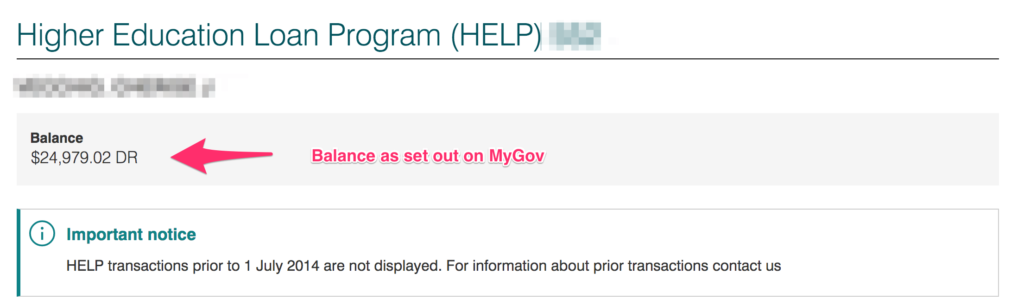
Checking HECS debt is easy. Jump on to your myGov account, and you’ll immediately see how much you’ve left to pay. If you don’t have an account, you can set up one through the ATO website.
How much are my HECS Repayments?
HECS repayments are determined by how much you’re earning. The lender will look at this percentage and take it off your entire loan.
So, let’s take a look at an example.
Case Study 2 – Layla’s HELP Debt

Layla is a 29-year-old junior doctor earning $105,000 per year. She has a HELP debt of $15,000 and wants to buy her first home in Melbourne.
Key Facts:
- Income: $105,000
- Current HECS Repayment: $5,700/year (15% of income over $67k)
- Deposit Saved: $90,000
- Other Debts: None
- HECS Balance: $15,000 (likely cleared in under 3 years at current rates)
Before HECS Policy Change:
Under traditional bank policies, lenders factored her full HECS repayment into her borrowing power calculation, treating it like a recurring liability. Combined with the old percentage-based system, this reduced her borrowing capacity by around $75,000.
After Current Policy Update:
Under APRA’s updated guidance, some lenders—like CommBank—can now ignore HECS debt if it’s likely to be repaid within 2-3 years. Additionally, the new marginal system means Layla keeps an extra $2,175 in “take-home pay” per year compared to the old rules.
Layla’s broker submits her application to CommBank, explaining:
- Her debt will be cleared rapidly due to her high-earning profession.
- She has no other liabilities like car loans or credit cards.
- The marginal system significantly improves her monthly cash flow.
Outcome:
Scenario | Estimated Borrowing Power |
With HECS included | $535,000 |
HECS excluded (due to new rules) | $610,000 |
Layla’s Result: She was able to borrow an extra $75,000—enough to buy a two-bedroom apartment closer to the hospital where she works.
Read More: How Much Home Can I Afford [Calculator]
Refinancing With HECS: Avoiding The "Mortgage Prison"
If you already own a home but feel stuck with your current lender, you might be in what the industry calls a “mortgage prison.” This happens when you want to switch to a better rate, but because of tighter lending rules, you “fail” the stress test at a new bank.
Why it’s harder to switch in 2026
Even if you’ve never missed a payment, a new lender has to look at your application as if you were a brand-new borrower. Here’s why your HECS debt might be keeping you “locked in”:
- The Indexation Double-Whammy: While the 20% debt cut in 2025 helped, the remaining balance still gets indexed every June. If your debt grew while your wages stayed flat, your Debt-to-Income (DTI) ratio might now be higher than when you first bought your home.
- The 3% “Stress Test”: Banks don’t just check if you can afford today’s rates. They add a 3% buffer to their current rate. When you add HECS repayments into that calculation, your “disposable income” can shrink fast in the eyes of a credit assessor.
- Lower Property Valuations: If your home’s value hasn’t grown as fast as your debt, your Loan-to-Value Ratio (LVR) could be higher, making banks even more nervous about that extra HECS liability.
How to break free
Don’t assume a “No” from your current bank means you’re stuck forever. Here are a few tricks to help you “jailbreak” your mortgage:
- Non-ADI Lenders: These are “non-bank” lenders. Because they aren’t Authorised Deposit-taking Institutions (ADIs), they aren’t always bound by the same strict APRA DTI caps as the big banks. They often have more common-sense ways of looking at student debt.
- Specific Refinance Policies: Some lenders have “Fast Track” refinance programs. If you have a clean repayment history for the last 12 months, they may reduce the “stress test” buffer, potentially ignoring the DTI impact of your HECS debt entirely.
- Strategic Debt Consolidation: Sometimes, it actually makes sense to roll a small HECS balance or a car loan into your mortgage. While we generally say “keep student debt separate,” if it’s the only thing stopping you from saving 1.5% on your total mortgage rate, the math might just work in your favour.
Feeling trapped in your current loan? Every bank has a different “appetite” for HECS debt. If one says no, another might say yes. Book a free assessment with our team, and let’s see if we can find a key to your mortgage prison.
Should I Pay Off My HECS Before Buying A House?
Deciding whether to pay off your HECS-HELP debt before buying a house depends on your income, borrowing goals, and financial strategy. For most first-home buyers, you don’t need to pay off your HECS debt before getting a home loan—but there are pros and cons to consider.
When Paying Off HECS Might Help
Paying off your HECS debt could slightly improve your borrowing power, especially if your income is high enough that your HECS repayments are substantial. For example, if you earn $100,000, your HECS repayment rate is around 7–8%, which lenders will treat like a financial liability. Eliminating it can boost how much you’re allowed to borrow.
Consider paying it off first if:
- You’re close to repaying the full balance anyway
- Your borrowing capacity is just short of the property you want
- You’re applying with a lender that heavily penalises HECS in their serviceability calculator
When It’s Better to Keep the HECS Debt
HECS is an interest-free loan indexed annually to inflation, which means it’s one of the cheapest debts you can carry. If you’re saving for a deposit or aiming to buy sooner, putting that money toward your home loan or upfront costs may have a greater financial impact.
Keeping your HECS may make more sense if:
- You’re early in your career or earning under the repayment threshold
- You’re prioritising a larger deposit or avoiding Lenders Mortgage Insurance (LMI)
- You’d prefer to invest in assets that might grow faster than inflation
Should I Make Voluntary Repayments?
This depends on where you sit with your financial situation.
- If you ONLY have HECS debt
- have no other forms of debt,
- you need to increase your borrowing capacity,
- AND you have some spare cash…
Well, why not? You can make voluntary repayments.
But if you have other sources of debt that are considered bad debt, like personal loans, car loans and credit cards, which have much higger interest rates, then this is where you should start because this form of debt is considered bad debt.
After that, student debt follows.
And then money into property and shares, which are considered good debt, can come into play.

In summary, student debt isn’t “make or break” when it comes to applying for a home loan. The good thing is that most people have HECs/HELP debt. So, it’s a pretty common aspect of applicants applying for a home loan.
What happens if I still have a high HELP balance?
f you’re still sitting within a reasonable amount left on your HECS debt—say, over $10,000, and it would be taking a significant amount off your savings to pay it off, then wait…
In this case, it’s not worth paying it off because it will leave you with less for other expenses.
The more critical debts to get rid of are car loans, personal loans and credit cards.
The ultimate goal should be to save for a deposit. HECS has no interest and takes off a small amount of your income. So, paying it down gradually works just as well.
How can I Improve My Chance Of Qualifying For A Home Loan With HECS Debt?
Yes, HECS debt adds a little extra hurdle to your loan application. But the good news is, there are a few ways to improve your chances of qualifying.
Reduce existing debt
Sorry to sound like a broken record, but reducing existing debt is a great way to increase your chances of home loan approval. Consolidate your debt where you can. However, pay attention to different interest rates that come with different terms. Adding the debt to your new mortgage is not always a good idea.
Why? Because it’s a 30-year time frame that will significantly add to your overall interest paid.
Check your credit
Good credit. Bad credit. Some credit. No credit. If you’re unsure where your credit stands, get in touch with our team to review.
Some people do a credit check and find out they’ve got bad credit without realising it. It could be anything, like a missed payment from over five years ago while you were overseas.
So before you apply for a loan, always do a credit check. This will help your mortgage broker determine the best lender for you, depending on your credit record. You will then be able to take steps to improve your credit status once you know where you stand.
Save, save, save away.
You might be sick of hearing the s-word, but it is the truth… Before you’re ready to apply for a home loan, make sure that you have been steadily Saving for at least three months.
Regular deposits into a savings account will show the lender that you are disciplined.
Speak to us ( mortgage brokers)
We are here to help you.
You can ensure that you qualify for a loan by speaking to a broker before proceeding with your application.
Your broker will check that you have all the paperwork and strategies in check. And they will also negotiate for the best rates on your behalf. #winning
If you would like to chat, contact our mortgage brokers or call us on 1300 088 065.
Be honest and always be conservative with income and asset estimation.
As we said about telling your broker about the HECS debt, try to establish a transparent and honest approach with them regarding your income and assets. After all, your income is shown on your payslip.
What about your yearly earnings? Many first-home buyers include their superannuation in their yearly income. But since this money doesn’t go into your pocket, it should be left out.
Making a sound estimate will help you stay in a stronger financial position later on…
We see all kinds of situations every day, deal with financial stress, and encounter unique situations all the time. So there is no need to be embarrassed about your financial situation. We’ve probably heard it before, anyway!
Make sure to include all expenses.
Any extra expenses, like childcare or phone bills that you haven’t factored in are essential. So, sit down and make a comprehensive list of all your monthly expenses. The lender will use this to determine how much you can afford to make in repayments.
Overapplying won’t help.
Every time you apply for a home loan, the lender will review your credit file. This review process is added to your credit file.
The next lender will be able to see a history of each time you have applied for a loan. And since no outcome is stated on your credit file, they will assume your previous application was unsuccessful. This history can be seen as a red flag by lenders.
In summary, only apply for a loan when you’re 100% ready and have all your ducks in a row.
FAQs - How Does Hecs Debt Affect Home Loans
Does HECS show up on my credit report?
No, HECS-HELP debt is not listed on your credit file, but lenders see it via your tax returns and payslips.
Can I get a home loan if I’m still a student?
Yes, but lenders may “notionalize” a future repayment amount if you are near graduation, which can reduce your borrowing limit.
Will HECS stop me from using the First Home Guarantee?
No, but it may lower the maximum property price you can afford within the scheme’s income caps.
What is the HECS indexation rate for 2026?
Under current policy, HECS-HELP indexation is capped at the lower of the Consumer Price Index (CPI) or the Wage Price Index (WPI) to ensure your debt never grows faster than your wages.
Does NAB treat HECS differently than CBA?
Yes, NAB may ignore HECS debt balances under $20,000 for serviceability, whereas CBA focuses on the repayment timeline.
Can I use a tax refund to pay off HECS before a mortgage?
Yes, and doing so before May 31 avoids the annual indexation increase.
Is HECS considered 'bad debt' by banks?
Not necessarily, but it is a “mandatory liability” that reduces your net take-home pay.
Does HECS affect my spouse’s borrowing power?
If applying jointly, the total household DTI is assessed, meaning one partner’s HECS affects the couple’s total limit.
Next Steps And Getting Your Home Loan
Our team at Hunter Galloway is here to help you buy a home in Brisbane. Unlike other mortgage brokers, who are one-person operations, we have an entire team of experts dedicated to making your home loan journey as simple as possible.
If you want to get started, please give us a call on 1300 088 065 or book a free assessment online to see how we can help.





 Start again